
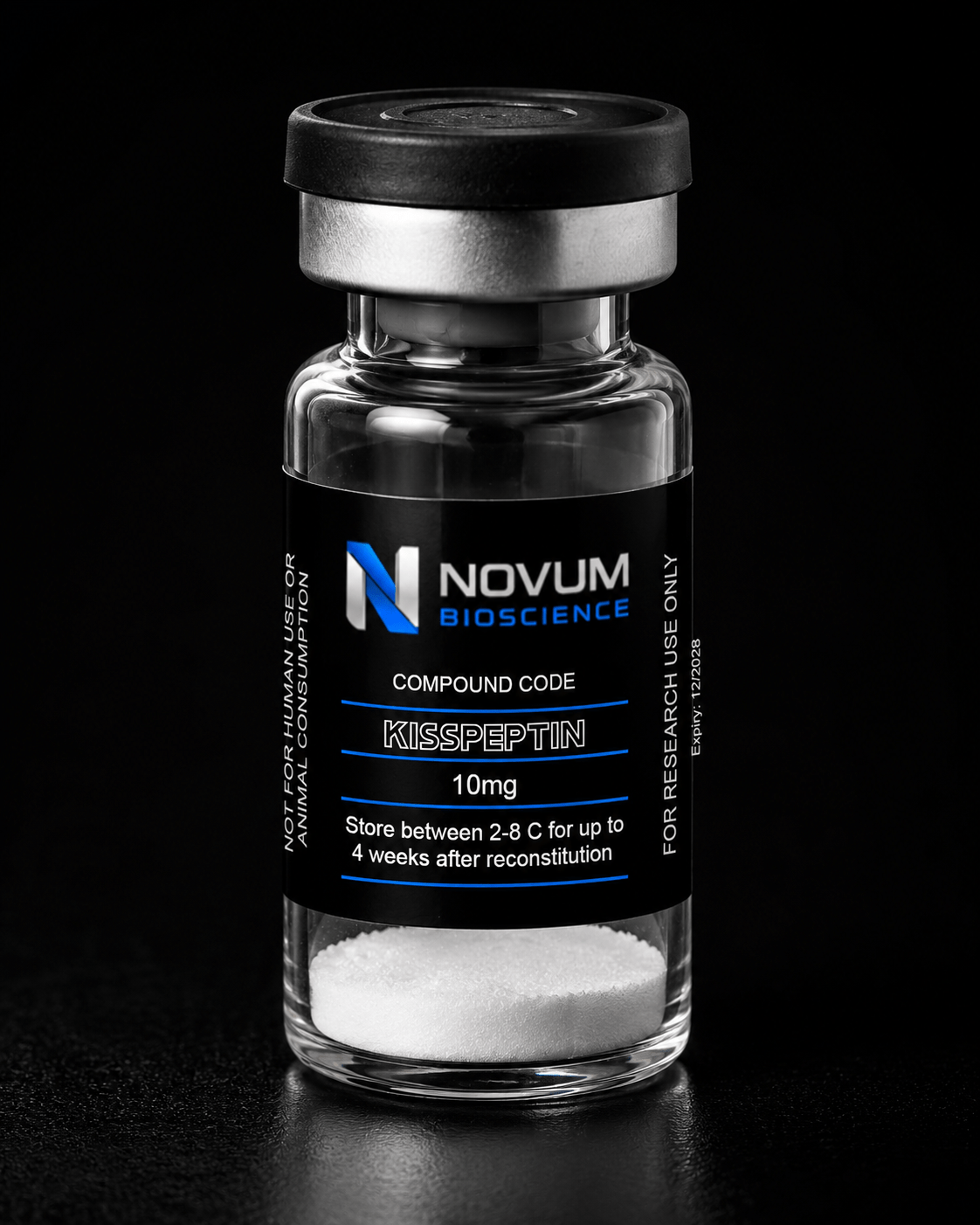
Kisspeptin 10mg


Original price was: $80.00.$75.00Current price is: $75.00.
Kisspeptin 10mg at a Glance
| Product | Kisspeptin 10mg |
|---|---|
| Product Type | Research peptide |
| Peptide | Kisspeptin-10 |
| Amount | 10mg |
| Form | Lyophilized powder |
| Sequence | YNWNSFGLRF-NH₂ |
| Molecular Formula | C₆₃H₈₃N₁₇O₁₄ |
| Molecular Weight | Approximately 1302.4 g/mol |
| Primary Receptor | KISS1R / GPR54 |
| Research Focus | KISS1/KISS1R signaling and reproductive neuroendocrinology |
| Storage | -20°C, protected from light |
| Intended Use | Laboratory research only |
Buy Kisspeptin 10mg Peptide For Sale Online Canada.
Kisspeptin 10mg is a research-grade peptide designed for laboratory studies of the KISS1/KISS1R signaling pathway, reproductive neuroendocrinology, hypothalamic-pituitary-gonadal (HPG) axis regulation, and peptide-receptor interactions. Kisspeptin is an endogenous neuropeptide derived from the KISS1 gene and acts through the KISS1R receptor, formerly known as GPR54. In reproductive biology, kisspeptin signaling is positioned upstream of gonadotropin-releasing hormone (GnRH), making it an important research target for investigating GnRH pulsatility, luteinizing hormone (LH), follicle-stimulating hormone (FSH), puberty, fertility, and sex-steroid regulation.
What Is Kisspeptin-10?
Kisspeptin-10 (KP-10) is the 10-amino-acid active core peptide derived from the larger kisspeptin precursor.
The human Kisspeptin-10 sequence is:
Tyr-Asn-Trp-Asn-Ser-Phe-Gly-Leu-Arg-Phe-NH₂
or:
YNWNSFGLRF-NH₂
PubChem lists Kisspeptin-10 under CID 25240297 with a molecular formula of C₆₃H₈₃N₁₇O₁₄ and a molecular weight of approximately 1302.4 g/mol.
Kisspeptin and KISS1R Research
The KISS1/KISS1R signaling pathway is one of the central research systems for understanding neuroendocrine reproductive regulation.
Kisspeptin binds to KISS1R on GnRH neurons and stimulates GnRH signaling. This provides an upstream regulatory mechanism connecting hypothalamic signaling with pituitary gonadotropin secretion.
Researchers can use Kisspeptin 10mg to investigate:
- KISS1R receptor activation
- Peptide-receptor interactions
- GnRH signaling
- LH and FSH regulation
- HPG-axis signaling
- Neuroendocrine feedback
- Reproductive hormone regulation
- Gonadal signaling
- Kisspeptin-mediated cellular pathways
Kisspeptin and the HPG Axis
The hypothalamic-pituitary-gonadal axis is a major biological system controlling reproductive function.
Kisspeptin occupies an important upstream position in this pathway.
1. Kisspeptin
Kisspeptin activates KISS1R-expressing neurons.
2. KISS1R
KISS1R signaling activates downstream neuronal pathways associated with GnRH release.
3. GnRH
GnRH acts on the pituitary to regulate gonadotropin secretion.
4. LH and FSH
LH and FSH participate in downstream reproductive and gonadal signaling.
This pathway makes kisspeptin an important experimental tool for studying the neuroendocrine control of reproduction.
Kisspeptin Research and GnRH Signaling
One of the most important reasons researchers study kisspeptin is its relationship with GnRH neurons.
Kisspeptin signaling provides an upstream mechanism capable of stimulating GnRH secretion. Human studies have demonstrated that kisspeptin administration can stimulate LH secretion and alter LH pulse frequency under experimental conditions.
For laboratory research, this creates opportunities to investigate:
- GnRH neuronal activation
- Pulsatile reproductive signaling
- KISS1R receptor function
- Neuroendocrine feedback loops
- Gonadotropin secretion
- HPG-axis regulation
Kisspeptin and LH/FSH Research
LH and FSH are major pituitary gonadotropins involved in reproductive physiology.
Because kisspeptin acts upstream of GnRH, the kisspeptin-KISS1R pathway provides researchers with a model for investigating how hypothalamic signaling influences downstream gonadotropin secretion.
Research has demonstrated that kisspeptin can stimulate LH secretion and influence LH pulse frequency in human experimental settings.
Kisspeptin research is therefore relevant to studies of:
- LH pulsatility
- FSH regulation
- Gonadotropin signaling
- Sex-steroid feedback
- Reproductive endocrinology
- HPG-axis dysfunction
Kisspeptin and Reproductive Biology
The kisspeptin system is involved in several stages of reproductive biology.
Research has connected KISS1/KISS1R signaling with:
- Pubertal development
- Reproductive maturation
- Adult reproductive function
- Gonadotropin regulation
- Sex-steroid feedback
- Female reproductive physiology
- Male reproductive physiology
- Fertility-related research
Reviews describe kisspeptin as a key regulator upstream of GnRH and an important component of the neuroendocrine control of reproduction.
Kisspeptin and Puberty Research
The discovery of KISS1R as a critical regulator of reproductive maturation significantly expanded understanding of puberty.
Genetic changes affecting KISS1/KISS1R signaling have been associated with altered reproductive development, including hypogonadotropic hypogonadism and precocious puberty.
This makes Kisspeptin 10mg relevant to experimental research examining:
- Pubertal signaling
- Neuroendocrine maturation
- GnRH activation
- KISS1R expression
- Gonadotropin regulation
- Sex-steroid feedback
Kisspeptin and Fertility Research
Kisspeptin is extensively studied in reproductive and fertility research because of its position upstream of GnRH.
Experimental studies have investigated kisspeptin signaling in conditions involving altered reproductive hormone secretion, including hypothalamic reproductive dysfunction and hypogonadotropic states.
Importantly, these findings represent research into biological mechanisms and potential applications rather than evidence that a research-grade Kisspeptin 10mg product is an approved fertility treatment.
Kisspeptin and Male Reproductive Research
Kisspeptin signaling is also studied in male reproductive biology.
Research has investigated relationships between kisspeptin signaling and:
- GnRH secretion
- LH regulation
- Leydig-cell activity
- Testosterone-related signaling
- Spermatogenesis
- Sperm function
- HPG-axis regulation
Reviews emphasize that kisspeptin is an important upstream regulator of reproductive endocrine signaling in males, while some peripheral reproductive roles remain areas of active investigation.
Kisspeptin and Female Reproductive Research
In female reproductive biology, kisspeptin research includes investigation of:
- GnRH pulsatility
- LH surges
- Ovulatory signaling
- Follicular development
- Ovarian function
- Sex-steroid feedback
- Reproductive aging
Different kisspeptin neuronal populations appear to participate in different aspects of reproductive regulation, including positive and negative sex-steroid feedback.
Kisspeptin and Metabolic Signaling
Kisspeptin research extends beyond reproduction.
Researchers are investigating interactions between kisspeptin signaling, nutritional status, metabolic inputs, and reproductive neuroendocrine function. The KISS1 system can integrate metabolic and environmental signals with reproductive regulation.
This makes Kisspeptin 10mg relevant to multidisciplinary studies involving:
- Neuroendocrinology
- Metabolic signaling
- Reproductive physiology
- Hormonal feedback
- Energy status and reproduction
Kisspeptin and Cancer Research
The KISS1 gene was originally identified in research involving metastatic suppression, which led to the alternative name metastin for kisspeptin-related peptides.
Subsequent research has investigated KISS1/KISS1R signaling in cancer biology, including tumor-cell migration and metastasis-related pathways.
However, these findings should be understood as an experimental cancer-biology research area. Kisspeptin 10mg should not be marketed as a cancer treatment or as a product proven to prevent metastasis.
Be the first to review “Kisspeptin 10mg”
Related products
Reviews
There are no reviews yet.