
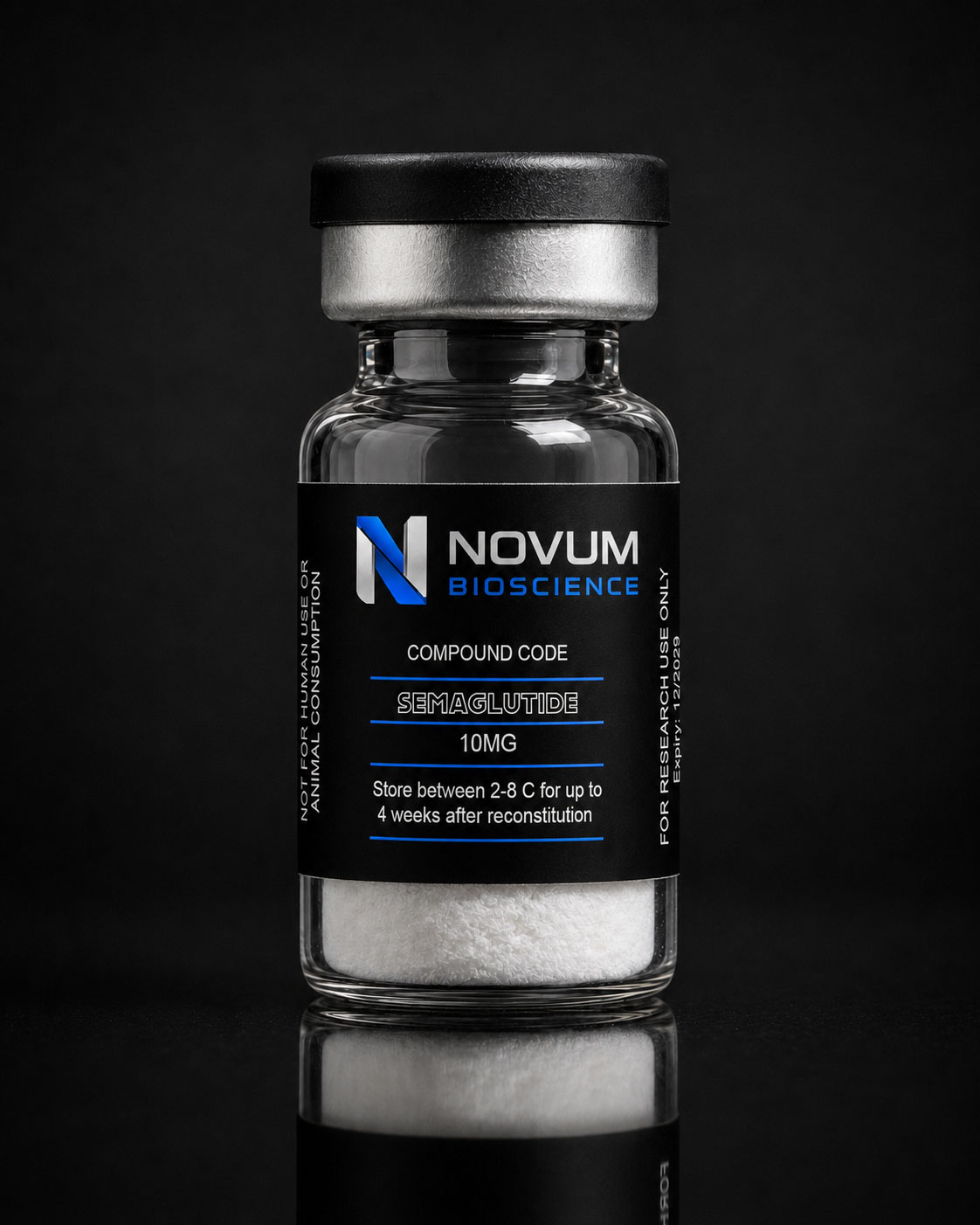
Semaglutide 10mg


$120.00
Semaglutide 10mg at a Glance
- Compound: Semaglutide
- Synonym: NN9535
- CAS: 910463-68-2
- Class: GLP-1 receptor agonist / GLP-1 analog
- Quantity: 10mg
- Form: Lyophilized powder
- Molecular formula: C₁₈₇H₂₉₁N₄₅O₅₉
- Molecular weight: approximately 4113.58 g/mol
- Purity: ≥95%, according to supplied product specifications
- Primary research areas: GLP-1 receptor signaling, metabolic research, endocrine signaling and energy-balance research
- Intended use: Laboratory research only
The molecular formula and molecular identity are independently consistent with PubChem, while current FDA labeling reports a molecular weight of 4113.58 g/mol.
Buy Semaglutide 10mg Online Canada.
Research-Grade Semaglutide Peptide | GLP-1 Receptor Research
Semaglutide 10mg is a synthetic peptide research compound used to investigate GLP-1 receptor signaling, metabolic pathways, endocrine communication, glucose regulation, appetite-related signaling and energy balance. Semaglutide is a modified analog of human glucagon-like peptide-1 (GLP-1). Its molecular structure incorporates modifications designed to increase stability and extend receptor interaction compared with native GLP-1.
What Is Semaglutide?
Semaglutide is a synthetic peptide based on the GLP-1 signaling system.
GLP-1 is an incretin hormone involved in physiological regulation of glucose metabolism and appetite. Semaglutide is structurally modified to interact with the GLP-1 receptor while exhibiting substantially greater stability and duration of activity than native GLP-1.
Because of these properties, semaglutide is widely studied as a model compound for investigating longer-lasting GLP-1 receptor activation and downstream cellular signaling.
Research involving semaglutide can examine receptor activation, intracellular signaling, metabolic responses and time-dependent biological effects under controlled experimental conditions.
Semaglutide 10mg and GLP-1 Receptor Research
The central research focus of semaglutide is its interaction with the GLP-1 receptor.
GLP-1 receptor activation can initiate intracellular signaling cascades, including pathways involving cyclic AMP (cAMP) and downstream protein signaling.
Researchers can use semaglutide as a model compound to investigate questions such as:
- How does sustained GLP-1 receptor activation affect cellular signaling?
- How does receptor activation change over time?
- How do GLP-1 analogs compare with native GLP-1?
- How does prolonged receptor engagement influence downstream signaling?
- How does receptor exposure affect cellular responsiveness?
This makes semaglutide particularly relevant to receptor pharmacology and metabolic signaling research.
Semaglutide and Glucose Signaling Research
GLP-1 receptor signaling is closely connected with glucose-regulatory mechanisms.
Semaglutide research can therefore be used to investigate the molecular relationship between GLP-1 receptor activation and pathways associated with glucose homeostasis.
Researchers may examine downstream signaling, cellular responses and changes in protein expression under controlled conditions.
The objective in a laboratory setting is to characterize biological mechanisms rather than to establish a therapeutic outcome from the research material.
Semaglutide and Insulin Signaling Research
Another important research area is the relationship between GLP-1 receptor activation and insulin-related signaling.
Experimental systems can be used to investigate how GLP-1 receptor stimulation affects pancreatic and metabolic signaling pathways and how those responses vary between experimental models.
Semaglutide therefore provides researchers with a defined GLP-1 analog for studying receptor-mediated metabolic communication.
Semaglutide and Glucagon Research
GLP-1 signaling is also associated with regulation of glucagon.
Semaglutide can be used in research examining how GLP-1 receptor activation influences the balance between insulin- and glucagon-associated metabolic signaling.
This is particularly relevant to laboratory models investigating glucose homeostasis and endocrine communication.
Semaglutide and Appetite Signaling Research
GLP-1 receptor signaling is also studied in relation to appetite and food-intake regulation.
Research has examined GLP-1 receptor activity in neural pathways involved in appetite and energy balance. Current regulatory information describes GLP-1 receptor involvement in areas of the brain associated with appetite regulation.
Semaglutide therefore provides a useful research model for investigating interactions between GLP-1 signaling, appetite-related pathways and energy regulation.
Semaglutide and Energy Balance Research
Energy balance involves interactions between food intake, metabolic processes, endocrine signaling and neural regulation.
Because semaglutide produces sustained GLP-1 receptor activation, researchers can use it to investigate how prolonged receptor signaling interacts with pathways involved in energy balance.
This includes research into:
- Appetite-related signaling
- Glucose metabolism
- Endocrine communication
- Metabolic regulation
- Energy intake
- Receptor-mediated cellular responses
Molecular Structure of Semaglutide
Semaglutide is a modified GLP-1 analog with a 31-amino-acid peptide backbone and additional structural modifications that increase its stability and prolong its biological activity.

Reviews
There are no reviews yet.