
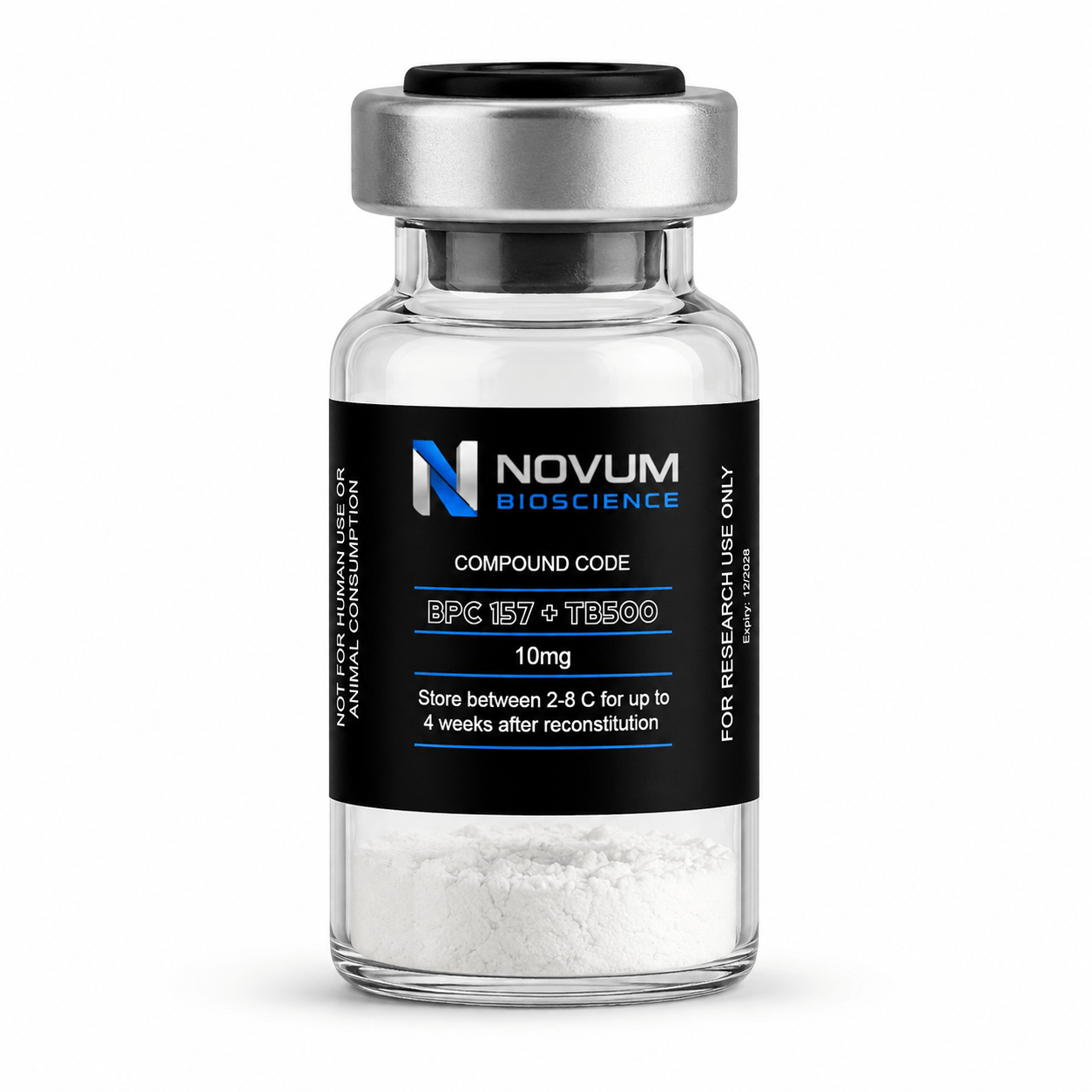
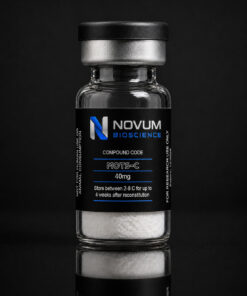
BPC 157 10mg + TB-500 10mg
$140.00
BPC-157 + TB-500 10mg/10mg at a Glance
| Product | BPC-157 10mg + TB-500 10mg |
|---|---|
| Common Name | Wolverine Stack |
| BPC-157 | 10mg |
| TB-500 | 10mg |
| Ratio | 1:1 |
| Total Peptide Content | 20mg |
| Form | Lyophilized powder |
| Salt/Form | Acetate salt |
| Purity | HPLC-verified |
| Identity | Mass spectrometry |
| Intended Use | Laboratory research |
| Research Areas | Tissue repair, regenerative biology, angiogenesis, cell migration, wound-healing research |
BPC-157 10mg + TB-500 10mg (Wolverine Stack) For Sale Online Canada.
BPC-157 10mg + TB-500 10mg is a research peptide blend combining two extensively investigated compounds in regenerative biology: BPC-157 and TB-500. Each vial contains 10mg BPC-157 and 10mg TB-500 in a 1:1 ratio, providing researchers with a convenient pre-blended formulation for laboratory studies. Often referred to as the Wolverine Stack, this BPC-157 and TB-500 combination is researched for complementary biological pathways associated with tissue repair, cell migration, angiogenesis, inflammation signaling, fibroblast activity, collagen remodeling, wound-healing biology, and musculoskeletal regeneration.
What Is BPC-157 + TB-500?
BPC-157 and TB-500 are two different research peptides that have attracted interest in regenerative and tissue-repair research.
BPC-157 is a 15-amino-acid peptide investigated in preclinical models involving tissue integrity, angiogenesis, inflammatory signaling, and musculoskeletal repair. A 2025 systematic review identified 36 relevant studies, of which 35 were preclinical and only one was clinical, highlighting the early stage of the human evidence.
TB-500 is commonly used to describe a synthetic peptide related to the active region of Thymosin Beta-4. Thymosin β4 research has examined actin regulation, endothelial-cell migration, angiogenesis, wound repair, and cellular remodeling.
BPC-157 for Tissue Repair Research
BPC-157 is particularly relevant to research involving muscle, tendon, ligament, and other connective tissues.
Preclinical studies have investigated BPC-157 in models of tendon injury, ligament injury, muscle injury, and bone-related repair. Research has explored changes in growth-factor signaling, inflammatory cytokines, collagen organization, and biomechanical outcomes.
This makes BPC-157 a frequently studied peptide in experimental regenerative medicine and musculoskeletal research.
TB-500 and Cellular Migration Research
TB-500 is associated with research surrounding the biological activity of the Thymosin Beta-4 actin-binding region.
Thymosin β4 interacts with G-actin and influences cytoskeletal dynamics. Experimental studies have investigated how these mechanisms affect cellular movement, endothelial-cell migration, angiogenesis, and tissue-repair processes.
This provides an important mechanistic research area for studies examining cell migration and tissue remodeling.
Angiogenesis and Vascular Research
Angiogenesis—the formation of new blood vessels—is an important component of tissue repair.
BPC-157 research has examined signaling pathways associated with angiogenesis and vascular responses. Thymosin β4 research has also demonstrated effects on endothelial-cell migration, vascular sprouting, and angiogenic activity in experimental models.
Researchers can therefore investigate the BPC-157 + TB-500 combination in experimental models where vascularization and tissue remodeling are important research endpoints.
Wound-Healing Research
Wound healing involves multiple biological processes, including:
- Inflammation
- Cell migration
- Angiogenesis
- Extracellular-matrix remodeling
- Collagen deposition
- Re-epithelialization
- Tissue maturation
Thymosin β4 has been investigated in experimental wound models involving re-epithelialization, collagen deposition, angiogenesis, and keratinocyte migration.
BPC-157 has separately been investigated in preclinical models involving tissue repair and inflammatory responses.
The combination therefore provides a useful research model for investigating multiple components of the regenerative process.
Musculoskeletal Regeneration Research
The BPC-157 + TB-500 blend is particularly relevant to experimental research involving:
- Tendons
- Ligaments
- Skeletal muscle
- Connective tissue
- Soft-tissue injury
- Tendon-to-bone interfaces
- Tissue remodeling
- Wound repair
BPC-157 has demonstrated promising findings across several animal models of musculoskeletal injury, although current reviews emphasize that these findings should not be interpreted as established human therapeutic efficacy.
Fibroblast and Collagen Research
Fibroblasts play a central role in extracellular-matrix formation and tissue remodeling.
BPC-157 research has investigated fibroblast-related mechanisms and collagen deposition in experimental tendon and connective-tissue models.
The combination can therefore be studied in laboratory models examining:
- Fibroblast activity
- Collagen deposition
- Extracellular-matrix organization
- Tissue remodeling
- Structural repair
- Biomechanical tissue properties
Inflammation and Tissue-Protection Research
Inflammatory signaling is closely connected to tissue injury and regeneration.
BPC-157 research has investigated inflammatory cytokine regulation and cellular protection in preclinical models. Thymosin β4 research has also examined inflammation-related mechanisms alongside its effects on migration and tissue repair.
The BPC-157 + TB-500 blend can therefore serve as a research tool for studying the relationship between inflammation, cellular migration, vascularization, and tissue remodeling.
BPC-157 + TB-500 Mechanism of Action
The two peptides are investigated through different but potentially complementary biological mechanisms.
BPC-157
Research has associated BPC-157 with pathways involving:
- Growth-factor signaling
- VEGF-related angiogenic activity
- Fibroblast responses
- Nitric oxide signaling
- Cellular migration
- Inflammatory signaling
- Tissue remodeling
TB-500 / Thymosin β4-Related Research
Thymosin β4 is a major intracellular G-actin-sequestering peptide. Its actin-binding activity influences cytoskeletal dynamics and has been associated experimentally with cell migration and angiogenesis.
Combined Research Interest
Studying BPC-157 and TB-500 together allows researchers to investigate several interconnected biological processes:
Cell signaling → cell migration → angiogenesis → extracellular-matrix remodeling → tissue repair
Importantly, the existence of complementary mechanisms does not establish that the combination produces a synergistic therapeutic effect in humans. Direct research on the specific 10mg/10mg blend remains limited.
Be the first to review “BPC 157 10mg + TB-500 10mg”
Related products
HCG & Peptides
Reviews
There are no reviews yet.